Knowing how to start an e-commerce business from scratch is one of the most valuable skills you can have in 2025 — and it’s far more accessible than most people think.
Global online retail sales are projected to surpass $8 trillion by 2027. Whether you’re a first-time entrepreneur or a brick-and-mortar owner ready to go digital, learning how to start an e-commerce business could change your financial future.
In this guide, you’ll discover every major step — from choosing your e-commerce model and building your website to handling digital marketing and scaling your store. We’ll also cover the key benefits of e-commerce, common limitations to plan around, and real-world e-commerce examples to inspire your journey.
Let’s get into it.
What Is E-Commerce — And Why It Matters
Before diving into the how-to, let’s quickly define what is e-commerce business. In simple terms, electronic commerce (e-commerce) refers to buying and selling goods or services over the internet. This includes everything from a solo seller on Etsy to a multinational retailer like Amazon.
It’s also important to understand the difference between e-commerce and e-business. While e-commerce focuses specifically on commercial transactions (buying and selling), e-business is broader — it covers all business processes that run digitally, including supply chain management, internal operations, and customer service systems. Knowing the difference between e-commerce and e-business helps you plan which tools and services you actually need.
Types of E-Commerce Models — Which One Fits You?
Choosing the right model is one of the most strategic decisions you’ll make. Here are the main types of e-commerce with examples to help you decide:
| Model | Description | Example |
|---|---|---|
| B2C | Business sells directly to consumers | Nike, ASOS |
| B2B | Business sells to other businesses | Salesforce, Alibaba |
| C2C | Consumer sells to consumer | eBay, Etsy |
| D2C | Brand sells directly, bypassing retailers | Warby Parker, Dollar Shave Club |
| Subscription | Recurring product or service delivery | HelloFresh, Spotify |
Most new entrepreneurs start with a B2C or D2C model because they have lower barriers to entry and allow you to build a brand directly with your customers.
Step-by-Step: How to Start an E-Commerce Business
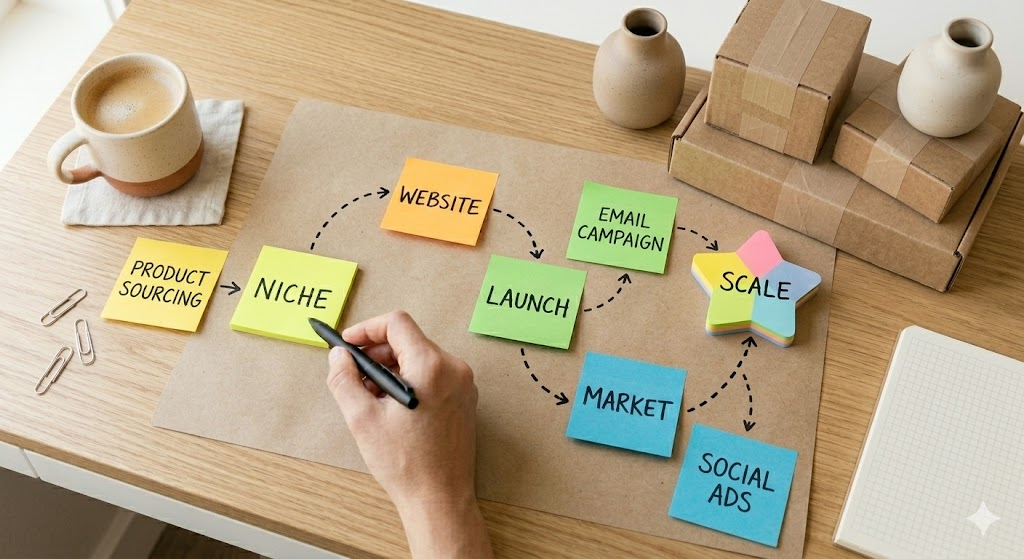
Now for the core of it. Follow these steps to launch a legitimate, scalable online shopping business from scratch.
Step 1 — Validate Your Product or Niche
Don’t build before you validate. Research search volume, competition, and real buyer intent. Tools like Google Trends, Reddit communities, and competitor research reveal whether a market actually exists.
Step 2 — Choose Your E-Commerce Model and Platform
Once you know what you’re selling, decide how you’ll sell it. Dropshipping, print-on-demand, private label, and digital products all have different logistics, margins, and startup costs. Match the model to your resources.
Then pick your platform — Shopify, WooCommerce, BigCommerce, and Wix are all solid options depending on your budget and technical comfort level.
Step 3 — Build Your E-Commerce Website
Your website is your storefront. It has to work beautifully, load fast, and earn trust in seconds. Poor design kills conversions before a product page even loads.
This is where professional help pays off. Oscend offers website design services tailored for e-commerce brands — creating clean, high-converting storefronts that reflect your brand and guide buyers to checkout.
A slow or confusing website is the #1 reason shoppers abandon their carts. See how Oscend builds e-commerce experiences that convert.
Explore website design services →Step 4 — Design for Experience, Not Just Aesthetics
Design isn’t just about looking good — it’s about guiding your visitor from landing page to checkout with zero friction. Navigation, product photography, trust signals (reviews, guarantees), and mobile responsiveness all contribute.
If you want data-backed design decisions, UI/UX design services from Oscend can audit and improve the experience your customers actually have — reducing drop-off and boosting average order values.
Step 5 — Set Up Payments, Shipping, and Legal Basics
You’ll need:
- A payment gateway (Stripe, PayPal, or your platform’s native checkout)
- Shipping rates and carrier accounts (USPS, UPS, DHL, or fulfillment centers)
- A registered business entity (LLC or sole proprietor depending on your country)
- A privacy policy, terms of service, and return policy
Step 6 — Develop a Digital Marketing Strategy
Your store won’t find customers on its own. This is where e-commerce and digital marketing become inseparable. A strong strategy typically combines:
- SEO — organic traffic from search engines over time
- Paid ads — Google Shopping, Meta, TikTok for faster reach
- Email marketing — retention, abandoned cart recovery, loyalty
- Social media — brand building, community, influencer collabs
- Content marketing — blogs, videos, guides that attract and educate buyers
For long-term organic traffic, working with an SEO services partner is one of the highest-ROI moves an early-stage e-commerce brand can make. Getting found on Google costs you nothing per click — unlike paid ads.
Oscend’s SEO team specializes in e-commerce — from product page optimization to technical SEO and link building that ranks.
See Oscend’s SEO services →Step 7 — Leverage Social Media Marketing
Social platforms aren’t optional anymore — they’re where your audience lives. Instagram, TikTok, Pinterest, and Facebook each offer organic and paid opportunities to reach potential buyers. The key is showing up consistently with content that educates, entertains, or inspires.
Oscend’s social media marketing services help e-commerce brands build content strategies, manage ad campaigns, and grow engaged audiences that convert into loyal customers.
Benefits and Limitations of E-Commerce
Understanding both sides helps you plan realistically. Here’s a clear breakdown of the advantages of e-commerce alongside the limitations you should prepare for.
Benefits of E-Commerce
- Low startup costs — No physical store, no lease, no full-time staff required on day one
- 24/7 availability — Your store works while you sleep
- Global reach — Sell to customers in any country with minimal additional cost
- Data-driven decisions — Analytics tools reveal exactly what’s working and what’s not
- Scalability — Digital infrastructure scales without proportional cost increases
Limitations to Plan Around
- High competition — Low barriers to entry mean many competitors in most niches
- Customer trust takes time — New stores struggle to win first-time buyers without reviews
- Shipping complexity — Returns, delays, and international logistics add friction
- Tech dependence — Website downtime or payment failures directly hit revenue
The importance of e-commerce is undeniable — but going in with clear eyes on both the advantages and challenges gives you a real edge over competitors who don’t plan for the hard parts.
Start Your E-Commerce Business — The Right Way
Learning how to start an e-commerce business from scratch is a process, not a single moment. From choosing your e-commerce model and building a conversion-focused website, to mastering digital marketing and refining the customer experience — every step compounds.
The good news: you don’t have to figure it all out alone. The right partners in design, SEO, and social media can cut your learning curve dramatically and help you compete with established e-commerce sites from day one.
Oscend works with e-commerce brands at every stage — from launch to scale. Whether you need a high-converting store, a smarter SEO strategy, or a social presence that actually drives sales, the team is ready.
Start building your online shopping business today — explore Oscend’s full e-commerce services →