If you’ve ever wondered about the diff between marketing and advertising, you’re not alone. Most business owners — and even many professionals at top marketing and advertising companies — use the two terms interchangeably. But they are not the same thing, and confusing them can cost you real money and missed opportunities.
In this comprehensive guide, we break down the 10 key differences between marketing and advertising in plain language. We’ll cover everything from scope and goals to how digital marketing and advertising have transformed modern business, what leading marketing and advertising firms actually do, and when your business advertising strategy needs to evolve.
Quick Answer
Marketing is the full strategic process — research, branding, pricing, distribution, and promotion. Advertising (including every ad in marketing) is one paid tool inside that strategy. Think of marketing as the game plan and advertising as one specific play within it.
What Is Marketing and Advertising?
Before we dive into the differences, let’s establish clear definitions — the kind of clarity that separates average marketing and advertising agency partners from exceptional ones.
📊 What Is Marketing?
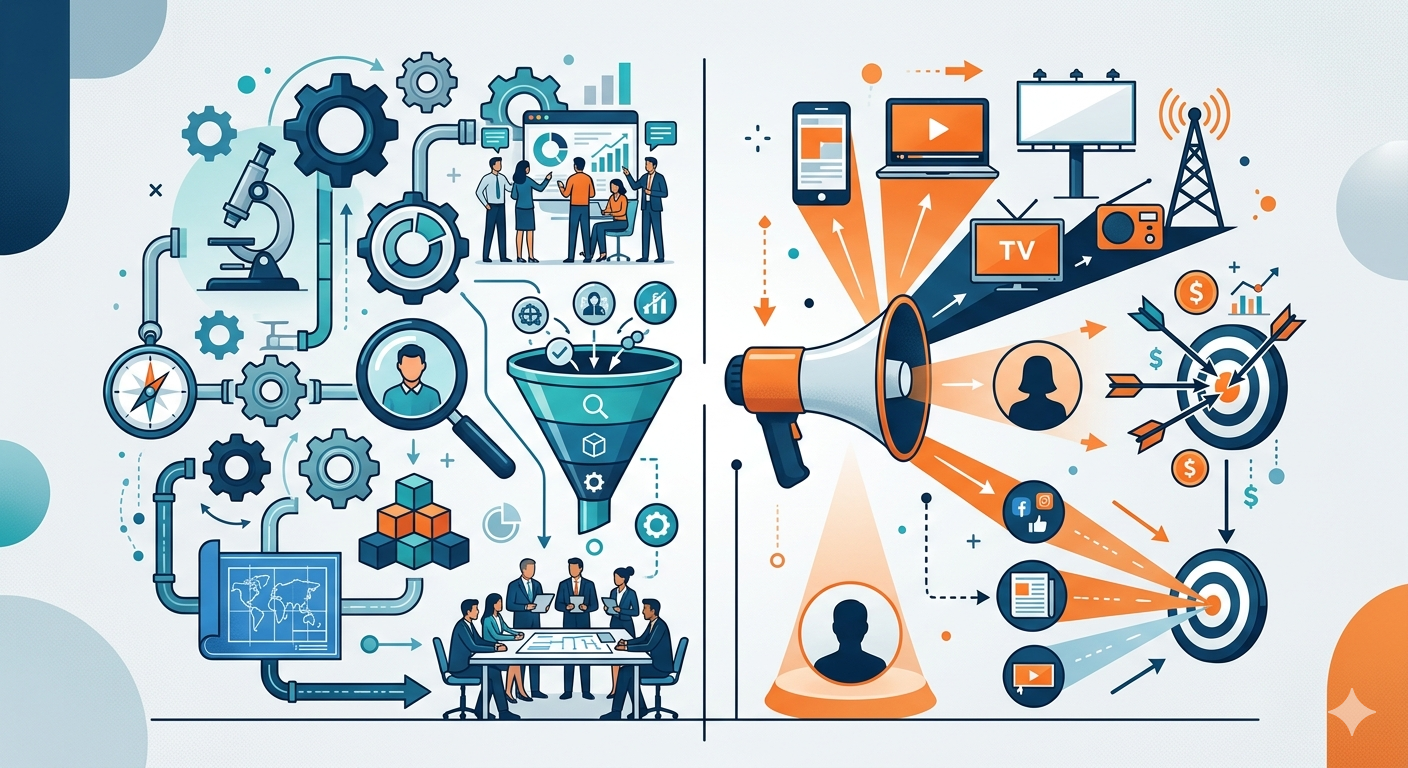
Marketing is the end-to-end process of identifying customer needs, developing products or services that satisfy them, pricing those offerings, choosing distribution channels, and promoting them. It encompasses research, branding, PR, social media, content, SEO — and yes, advertising.
📢 What Is Advertising?
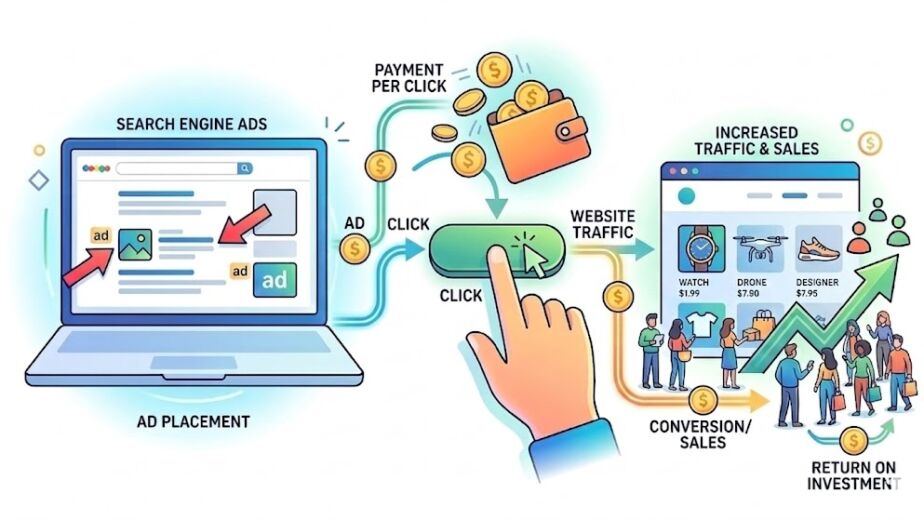
What is advertising, exactly? It’s a paid, non-personal form of communication used to promote a product, service, or idea through paid channels — TV, radio, print, billboards, search advertising ads, social ads, and display banners. It is a subset of marketing, not a replacement for it.
“Marketing is the orchestra. Advertising is the trumpet solo. Beautiful on its own — but meaningless without the rest of the band.”
10 Key Differences Between Marketing and Advertising
Here’s a detailed breakdown of every major distinction — perfect for anyone evaluating marketing and advertising companies or building their own strategy from scratch.
1. Scope & Breadth
Marketing covers the entire journey from market research and product development to customer retention and loyalty programs. Advertising focuses specifically on creating and placing paid messages to generate awareness or drive action. Top marketing and advertising firms always distinguish between a client’s full marketing strategy and their advertising spend — because budgeting and measuring them together leads to poor decisions.
Marketing = Broad Advertising = Narrow
2. Goals & Objectives
The goal of marketing is long-term — building brand equity, customer relationships, and sustainable growth. The goal of advertising, including every ad in marketing, is typically short-to-medium term: drive traffic, generate leads, or boost sales during a specific campaign window. Business advertising campaigns have defined start and end dates; marketing never truly stops.
Marketing = Long-term Advertising = Short-term
3. Cost & Budget Allocation
Marketing budgets span salaries, technology, content creation, events, SEO tools, and more. Advertising ads budgets are specifically media spend — what you pay to place your message in front of an audience. Many marketing and advertising companies bill these separately because the accounting treatment, attribution models, and ROI metrics differ significantly.
Marketing = Broader Budget Advertising = Media Spend
4. Process vs. Tool
Marketing advertising strategy is a process — a structured, ongoing discipline involving multiple departments: product, sales, data, and creative. Advertising is a tool within that process. You can run a complete marketing operation without paid ads (think content marketing, SEO, and referral programs). You cannot run effective advertising without a marketing strategy guiding it.
Marketing = Process Advertising = Tool
5. Communication Direction
Marketing is increasingly two-way — brands listen to customers, gather feedback, respond to reviews, and build communities. Traditional advertising is one-way communication: the brand pushes a message to a mostly passive audience. In digital marketing and advertising, the lines blur (social ads allow comments, shares, and interaction), but the fundamental intent still differs between the two.
Marketing = Two-way Advertising = One-way
6. Time Horizon of Results
Marketing activities like SEO, brand building, and content marketing compound over time — results may take months or years to fully materialize. Business advertising (especially paid search and social ads) can generate leads within hours of going live. This is why the best marketing and advertising agency partners recommend a blend: ads for immediate results, and sustained marketing for lasting growth.
Marketing = Months/Years Advertising = Days/Weeks
7. Channels Used
Marketing channels include SEO, email, content, PR, organic social media, events, partnerships, and customer service touchpoints. Advertising channels are specifically paid: Google Ads, Meta Ads, display networks, programmatic, TV, radio, print, outdoor, and sponsored content. In digital marketing and advertising, channels often overlap — but the paid vs. organic distinction remains critical for budgeting and attribution.
Marketing = Paid + Organic Advertising = Paid Only
8. Audience Relationship
Marketing advertising strategy builds a relationship with your audience over time — nurturing leads, educating customers, and creating loyal brand advocates. Advertising interrupts an audience with a message, often reaching people who have never heard of you before. The best marketing and advertising firms use advertising to initiate the relationship, then deploy marketing to deepen and sustain it.
Marketing = Relationship Advertising = Interruption
9. Measurability & Metrics
Advertising — especially digital marketing and advertising through platforms like Google and Meta — offers near-perfect measurability: impressions, clicks, conversions, ROAS, and cost per acquisition. Marketing metrics are broader and harder to isolate in isolation: brand awareness, Net Promoter Score (NPS), customer lifetime value (CLV), and overall market share. Both matter, but they require different analytical frameworks.
Marketing = Brand Metrics Advertising = Performance Metrics
10. Strategy vs. Execution
Marketing is fundamentally strategic — it defines your positioning, your ideal customer profile, and the story your brand tells. Advertising is fundamentally executional — it takes that strategy and delivers a specific message at a specific time to a specific audience. When you hire a marketing and advertising agency, the best ones do both: they set the overarching strategy and execute campaigns with precision across every relevant channel.
Marketing = Strategy Advertising = Execution
Quick-Reference: Marketing vs. Advertising at a Glance
Use this table for a side-by-side snapshot of the core diff between marketing and advertising:
| Factor | 🔴 Marketing | 🔵 Advertising |
|---|---|---|
| Definition | Full strategic process | Paid promotional communication |
| Scope | Broad (research to retention) | Narrow (message placement) |
| Primary Goal | Long-term brand growth | Short-term awareness & conversion |
| Budget | Multi-channel investment | Media / ad spend |
| Communication | Two-way dialogue | One-way broadcast |
| Channels | Paid + earned + owned | Paid media only |
| Results Timeline | Months to years | Immediate to weeks |
| Key Metrics | CLV, NPS, brand equity | CTR, CPA, ROAS, impressions |
| Digital Tools | SEO, CRM, Email, Organic Social | Google Ads, Meta Ads, Display |
| Nature | Strategic | Executional |
What Do Marketing and Advertising Agencies Actually Do?
The best marketing and advertising companies offer a full spectrum of services — bridging strategy and execution across every channel. Here’s what you can typically expect when working with a full-service marketing and advertising agency:
- Brand strategy, positioning, and identity design
- Market research and customer persona development
- Search engine optimisation (SEO) and content marketing
- Digital marketing and advertising — PPC, social media ads, email, retargeting
- Creative production: ad copy, video, graphics, and landing pages
- Media planning and buying for paid advertising ads across channels
- Public relations (PR) and influencer partnerships
- Analytics, conversion rate optimisation (CRO), and monthly reporting
- Business advertising campaigns across Google, Meta, LinkedIn, TikTok, and beyond
How Digital Marketing and Advertising Changed Everything
The rise of digital marketing and advertising has compressed the gap between marketing strategy and advertising execution like never before. Here’s why it matters for your business.
In the traditional world, you’d spend months developing a marketing strategy, then hand a creative brief to your advertising agency to produce a campaign that would run for weeks or months. Today, an ad in marketing can go live within minutes — tested, optimised, and scaled in real time based on actual data.
Platforms like Google, Meta, LinkedIn, and TikTok have made it possible for even small businesses to run sophisticated business advertising campaigns with granular audience targeting and instant performance feedback. The barrier to entry has never been lower.
But this speed has a significant downside: many brands skip the marketing fundamentals entirely and jump straight to advertising. The result? Expensive ads that don’t convert — because they lack the strategic foundation that only a proper marketing process can provide. The most successful marketing and advertising firms insist on strategy before execution, every single time.
Frequently Asked Questions
What is the main diff between marketing and advertising?
What is advertising in simple terms?
Should I hire a marketing agency or an advertising agency?
Is digital marketing the same as online advertising?
Can small businesses do marketing without advertising?
Conclusion: Marketing and Advertising Work Best Together
Understanding the diff between marketing and advertising is not just an academic exercise — it has real implications for how you allocate your budget, hire your team, and measure success. Marketing is the strategy; advertising is one of its most powerful tools.
Whether you’re evaluating marketing and advertising companies, building an in-house team, or simply trying to grow your brand more efficiently, starting with this distinction will save you time, money, and frustration. The brands that win long-term are those that invest in both — a solid marketing foundation and smart, targeted advertising to amplify it.
If you’re ready to build a more strategic approach to marketing advertising for your business, the first step is always clarity on where you are and where you want to go.
Ready to Build a Smarter Strategy?
Whether you need a full-service marketing and advertising agency or expert guidance on digital campaigns — start with a clear strategy. Let’s talk.