
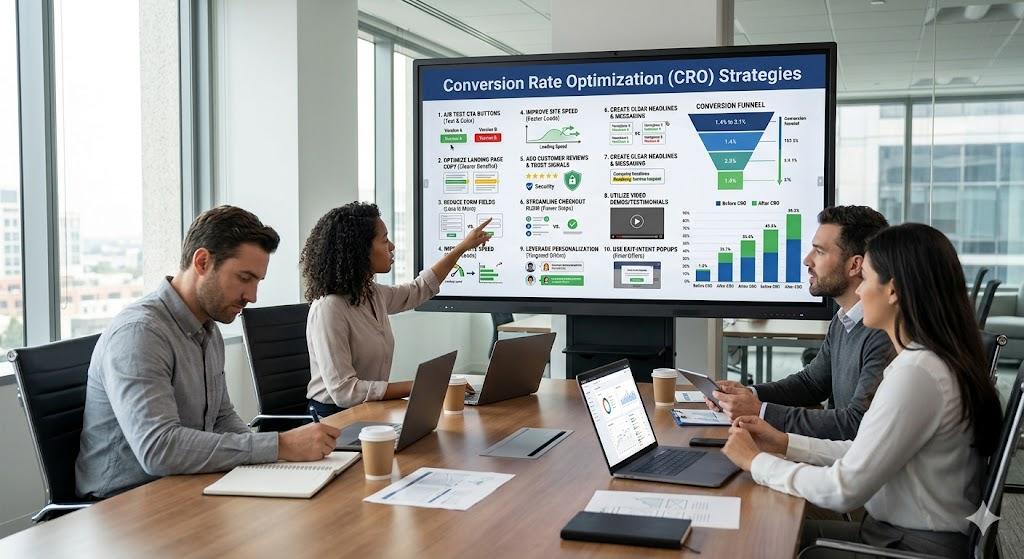
What are conversion rate optimization strategies? They are structured, data-driven techniques — such as A/B testing, landing page optimization, and reducing checkout friction — designed to remove barriers and guide visitors toward completing a goal. These strategies work hand-in-hand with great website design services, because a site that feels fast, credible, and effortless is already halfway to converting.
In this guide, you’ll find 10 proven conversion rate optimization strategies that deliver measurable results, whether you’re running an e-commerce store, a SaaS product, or a service-based business.
Key Statistics
| Metric | Figure |
|---|---|
| Average e-commerce conversion rate globally | 3.68% |
| Average ROI from CRO tools (Forrester) | 223% |
| Page load delay impact | 1 sec delay = 7% fewer conversions |
Table of Contents
- What Is CRO?
- Run Structured A/B Tests
- Optimize Your Landing Pages
- Improve Page Load Speed
- Build Social Proof and Trust
- Write Compelling, Clear Calls-to-Action
- Reduce Friction in Forms and Checkouts
- Use Personalization to Drive Relevance
- Deploy Exit-Intent Popups Strategically
- Analyze Heatmaps and Session Recordings
- Optimize for Mobile First
What Is CRO?
Definition: Conversion rate optimization (CRO) is the systematic process of increasing the percentage of website visitors who complete a desired action — whether that’s making a purchase, filling out a form, signing up for a newsletter, or any other goal that matters to your business.
To understand what is CRO in practical terms, consider this simple formula:
Conversion Rate = (Number of Conversions ÷ Total Visitors) × 100
For example, if 5,000 people visit your landing page and 150 complete a purchase, your conversion rate is 3%. Conversion rate optimization is everything you do to make that number higher — without necessarily spending more on ads or traffic acquisition.
This is what makes CRO one of the highest-leverage activities in digital marketing. Instead of spending $10,000 more on paid traffic, you could double revenue by improving how your existing traffic converts.
Key Insight: A 1% improvement in conversion rate can translate to tens of thousands of dollars in additional revenue, depending on your traffic volume and average order value.
1. Run Structured A/B Tests
A/B testing is the backbone of any serious conversion rate optimization program. Instead of guessing what works, you test two versions of a page element — a headline, button color, image, or layout — and let real user data decide the winner.
How to do it right:
- Test one variable at a time to isolate its impact.
- Run tests until you reach statistical significance (95%+ confidence).
- Prioritize high-traffic pages for faster results.
- Document your findings to build institutional knowledge.
Tools: Google Optimize (sunset), VWO, Optimizely, AB Tasty, or Convert.com are excellent platforms for structured A/B testing.
2. Optimize Your Landing Pages
Your landing pages are the front door of your funnel. A poorly designed landing page bleeds conversions. A core part of conversion rate optimization is ensuring every element on the page serves one goal: getting the visitor to take action. This starts with professional website design services that prioritize clarity, speed, and user intent from the ground up.
Landing page CRO checklist:
- Singular focus: Remove navigation links that pull visitors away.
- Clear value proposition: Communicate the benefit within 5 seconds of arrival.
- Visual hierarchy: Guide the eye toward the CTA using contrast and whitespace.
- Benefit-led copy: Speak to outcomes, not features.
- Trust indicators: Badges, logos, guarantees near the form or button.
3. Improve Page Load Speed
Page speed is not just a ranking factor — it’s a critical conversion rate optimization lever. Research from Google shows that as page load time increases from 1 second to 5 seconds, the probability of bounce increases by 90%. This is a key focus area for any professional SEO services provider, since speed improvements benefit rankings and conversions in equal measure.
Speed optimization priorities:
- Compress and serve images in next-gen formats (WebP, AVIF).
- Minimize render-blocking JavaScript and CSS.
- Implement a Content Delivery Network (CDN).
- Enable browser caching and lazy loading.
- Aim for a Core Web Vitals score in the “Good” range.
Run a free audit on PageSpeed Insights or GTmetrix to identify your biggest bottlenecks.
4. Build Social Proof and Trust
People buy from businesses they trust. One of the most impactful CRO strategies is systematically adding social proof throughout your site — not just on a dedicated testimonials page, but at every point of hesitation in the buyer journey.
Effective social proof formats:
- Star ratings and written reviews near add-to-cart buttons.
- Case studies with specific, quantifiable results (e.g., “Increased revenue by 34% in 60 days”).
- Customer logos (“Trusted by 10,000+ businesses”).
- Real-time notifications (“Sarah from Chicago just purchased”).
- Media mentions and third-party certifications.
5. Write Compelling, Clear Calls-to-Action
Your call-to-action (CTA) is the tipping point of every conversion. In conversion rate optimization, even small changes to CTA copy, color, size, or placement can produce dramatic lifts. Strong UI UX design services ensure your CTAs are positioned within a visual hierarchy that naturally draws the user’s eye — making the decision to click feel intuitive, not forced.
CTA best practices:
- Use first-person verbs: “Start my free trial” outperforms “Start free trial”.
- Be specific: “Get my 30-day plan” beats “Submit”.
- Create urgency without being spammy: “Claim your spot — only 3 left”.
- Make the button visually unmissable — use contrast, size, and whitespace.
- Test button placement above the fold AND after key benefit statements.
6. Reduce Friction in Forms and Checkouts
Friction is the silent conversion killer. Every unnecessary field, confusing step, or unexpected cost in your checkout process is a reason for a visitor to abandon. Conversion rate optimization demands a ruthless approach to simplification.
Friction-reduction tactics:
- Cut form fields to the absolute minimum required.
- Enable guest checkout — never force account creation before purchase.
- Display all costs (shipping, taxes) early to eliminate surprise.
- Use inline validation so errors are flagged before form submission.
- Offer multiple payment methods including digital wallets.
- Add a progress indicator for multi-step forms or checkouts.
Stat: Baymard Institute research shows the average documented online cart abandonment rate is nearly 70%. Reducing friction is the single highest-impact fix for most e-commerce businesses.
7. Use Personalization to Drive Relevance
Personalization is advanced conversion rate optimization — and it works because relevance reduces hesitation. When a visitor sees content, offers, or messaging that speaks directly to their context, they’re far more likely to convert.
Personalization strategies:
- Geo-targeting: Show location-specific offers, prices in local currency, or nearby store info.
- Behavioral triggers: Show returning visitors content based on their previous browsing history.
- Traffic source personalization: Match landing page messaging to the ad or email that brought the visitor.
- Segmented email flows: Tailor nurture sequences based on behavior and interests. Paired with dedicated email marketing services, personalized email campaigns can re-engage visitors who didn’t convert on first visit and bring them back ready to buy.
8. Deploy Exit-Intent Popups Strategically
Exit-intent technology detects when a user is about to leave your page and triggers a targeted message. When done tastefully, it’s a powerful CRO tool that recaptures visitors who would otherwise be lost.
High-converting exit popup ideas:
- Offer a discount or free shipping for first-time buyers.
- Promote a lead magnet (e.g., free guide, checklist, or webinar) and follow up via email marketing services to nurture captured leads through the funnel.
- Address the #1 objection your audience has.
- Provide a comparison or social proof to overcome hesitation.
Keep copy concise, the design clean, and always include a polite dismiss option. Aggressive popups hurt UX and conversions long-term.
9. Analyze Heatmaps and Session Recordings
Numbers tell you what is happening; behavioral analytics tell you why. Heatmaps and session recordings are essential qualitative tools in any conversion rate optimization toolkit. The patterns they reveal — misaligned clicks, ignored CTAs, form drop-offs — are exactly the insights that inform better UI UX design services and smarter page layouts.
What to look for:
- Click heatmaps: Are visitors clicking on non-clickable elements? That’s a UX misalignment you can fix.
- Scroll maps: Is your CTA above the fold for most visitors, or buried below where most people stop scrolling?
- Session recordings: Watch real user sessions to identify rage clicks, hesitation patterns, and drop-off points.
- Form analytics: Identify which form fields cause the most abandonment.
Tools: Hotjar, Microsoft Clarity (free), FullStory, and Crazy Egg are the most popular platforms for this type of analysis.
10. Optimize for Mobile First
Mobile traffic now accounts for over 60% of global web visits — yet mobile conversion rates consistently lag behind desktop. Closing this gap is one of the biggest opportunities in conversion rate optimization today.
Mobile CRO essentials:
- Use large, thumb-friendly tap targets (minimum 44×44px).
- Eliminate horizontal scrolling and pinch-to-zoom requirements.
- Simplify navigation — use a hamburger menu or sticky bottom bar.
- Auto-fill forms where possible using browser autofill and payment APIs.
- Test on real devices, not just browser emulators.
- Ensure pop-ups are non-intrusive and dismissible on small screens.
Google’s mobile-first indexing means mobile UX affects both SEO services and conversion rate optimization simultaneously — a double win when you get it right. A fast, thumb-friendly mobile experience doesn’t just rank better; it converts better too.
Putting It All Together: Your CRO Roadmap
Understanding what is CRO is just the starting point. The real power of conversion rate optimization strategies comes from building a continuous, data-driven improvement cycle — observe, hypothesize, test, learn, and iterate. Working with an experienced digital marketing agency like Oscend can dramatically accelerate this process, bringing proven frameworks, dedicated expertise, and cross-channel strategy to your optimization efforts.
You don’t need to implement all 10 strategies at once. Start by auditing your highest-traffic, lowest-converting pages. Pick the two or three strategies most relevant to your audience and business model, and run structured tests.
Over time, these incremental improvements compound. A 10% lift this quarter plus a 15% lift next quarter doesn’t just add up — it multiplies, because each improvement creates a stronger baseline for the next one.
Quick-Start Priority List: If you’re just beginning with conversion rate optimization, start with these three: (1) speed optimization, (2) improving your CTA copy, and (3) adding social proof near your key conversion points. These have the widest applicability and fastest time-to-impact.
Ready to Start Optimizing?
Partner with Oscend — a results-driven digital marketing agency offering website design, UI/UX, SEO, and email marketing services built around your conversion goals.