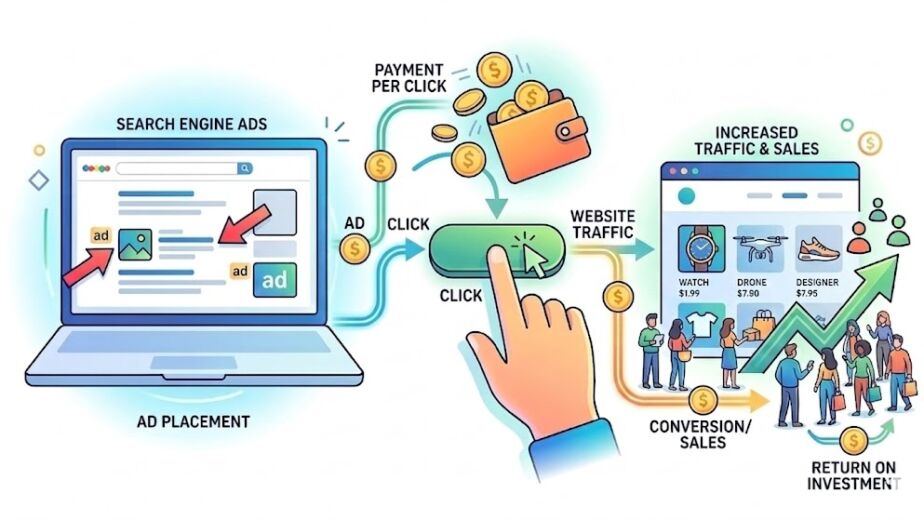

Every impression your ad or search result gets is an opportunity — but only if someone actually clicks. CTR, or click-through rate, is the metric that tells you exactly how often people are taking that action. Understanding what is CTR in digital marketing — and why it matters — is one of the fastest ways to improve the ROI of everything you publish online.
Whether you’re running Google Ads, optimizing organic search listings, or fine-tuning an email campaign, your click-through rate is a live signal of how well your message connects with your audience. In this guide, you’ll learn what CTR means, how to calculate it, what a good CTR looks like across different channels, and how to improve it.
What Does CTR Stand For?
CTR stands for click-through rate. In marketing, it measures the percentage of people who saw your link, ad, or listing and then clicked on it. The term appears across nearly every digital channel — search engines, social media, display advertising, and email — making it one of the most universal metrics in the industry.
Put simply: CTR tells you if your message is compelling enough to earn a click. A high CTR means your headline, ad copy, or subject line is doing its job. A low CTR is a signal that something needs to change — the message, the targeting, or both.
Key takeaway: CTR stands for click-through rate. It measures how many people click your link vs. how many saw it. High CTR = your message is resonating.
How to Calculate Click-Through Rate?
The click-through rate equation is straightforward. You divide the number of clicks by the number of impressions, then multiply by 100 to get a percentage.
CTR (%) = (Total Clicks ÷ Total Impressions) × 100
Example: If your Google ad received 500 clicks from 20,000 impressions, your CTR would be 2.5%. The same click-through rate equation applies whether you’re looking at paid ads, organic search results, or email campaigns.
Most platforms — Google Ads, Google Analytics, Meta Ads Manager, and email tools — calculate this automatically. Still, understanding the formula helps you interpret the number in context, especially when comparing performance across channels.
What Is a Good CTR? Benchmarks by Channel
There’s no single answer to what is a good click-through rate — it depends entirely on where you’re measuring. A 5% CTR could be mediocre for an email subject line and exceptional for a display ad. Context is everything.
Here’s a quick breakdown of typical CTR benchmarks across channels:
- Google Search Ads: 3–5% is considered good; top-performing ads regularly hit 8–10%
- Display / Banner Ads: The average ad click rate hovers around 0.1% — anything above 0.35% is strong
- Organic Search (SEO): Position 1 averages around 28–30%; even position 3 drops to roughly 11%
- Email Marketing: A good click-through rate sits between 2–5% of delivered emails; varies by industry
- Social Media: CTR in social media marketing services is typically 0.5–1.5% depending on the platform and format
Key takeaway: Always benchmark CTR within your specific channel and industry. Comparing your search CTR to your display CTR will lead you astray.
CTR in SEO: Why Organic Click-Through Rate Matters
In SEO, your website click-through rate is more than a vanity metric. Google has repeatedly confirmed that it uses engagement signals — including clicks — to understand whether a result is satisfying user intent. A consistently low organic CTR tells Google that searchers aren’t finding your listing compelling, which can hurt your rankings over time.
Understanding what is click-through rate in SEO means paying close attention to three things: your title tag, your meta description, and your URL structure. These are the only elements a searcher sees before deciding whether to click. Optimizing each one is the single highest-leverage activity for improving your average click-through rate in organic search. Working with professional seo services ensures these elements are consistently optimised across every page on your site.
The page CTR metric inside Google Search Console (found under Performance → Search Results) shows you exactly which pages are earning strong organic CTRs and which ones are underperforming relative to their ranking position. A page ranking in position 2 with a 4% CTR is leaving a massive amount of traffic on the table — the expected rate should be closer to 15–20%.
CTR in Google Ads and Paid Search
For paid campaigns, CTR is directly tied to your budget efficiency. In Google Ads, a high CTR improves your Quality Score — a composite metric Google uses to determine your ad rank and cost-per-click. Ads with higher Quality Scores pay less for the same position, which means investing in paid search marketing services can literally reduce how much you spend per click over time.
That said, chasing a high CTR in isolation can backfire. If your ad copy over-promises and attracts clicks from unqualified visitors, your conversion rate will suffer. The right goal is always a high CTR from qualified traffic — people who are genuinely interested in what you offer.
What is a good CTR for Google Ads? Across all industries, the average sits around 3–4%. Highly competitive sectors like legal or insurance often see lower CTRs because of dense SERP competition, while niche B2B ads can exceed 8–10% when targeting intent is precise.
Scaling paid CTR performance across channels is where performance marketing services make the biggest difference — combining data, creative, and targeting into a single, conversion-focused system.
Click-Through Rate vs. Conversion Rate: What’s the Difference?
A common source of confusion is click-through rate vs. conversion rate. Here’s the distinction:
- CTR measures how many people click on your link or ad out of everyone who saw it.
- Conversion rate measures how many people complete a desired action (purchase, signup, form fill) out of everyone who clicked.
CTR gets people to your site. Conversion rate determines what they do when they arrive. Both metrics matter, and optimising only one without the other leads to an incomplete picture. A well-structured marketing funnel ties the two together — ensuring the clicks you earn actually lead to conversions, not just traffic.
How to Increase Click-Through Rate: Practical Tactics?
Improving your CTR doesn’t require a full campaign overhaul. Small, targeted changes to your ad copy, title tags, or email subject lines can produce measurable results within days. Here are the most effective ways to increase click-through rate across channels:
For Organic Search (SEO)
- Write title tags under 60 characters that lead with the user’s intent, not your brand name
- Use power words and numbers in titles (e.g., “7 Ways,” “Complete Guide,” “In 2025”)
- Write meta descriptions that read like a mini-pitch — include a benefit and a subtle CTA
- Use structured data (schema markup) to unlock rich results like star ratings, FAQs, and breadcrumbs — these visually expand your listing and improve CTR
- Support your SEO with strong content marketing services to ensure every page has a clear topic, audience, and search intent behind it
For Paid Ads
- Match your headline directly to the search term using dynamic keyword insertion
- Add ad extensions (sitelinks, callouts, structured snippets) to increase ad real estate
- Test different CTAs — “Get a Free Quote” vs. “Start Today” can produce dramatically different results
- Use emotional triggers and urgency carefully — they work, but authenticity matters
- Run social media advertising agency services alongside search ads to reinforce your message across multiple touchpoints and drive higher combined CTRs
For Email
- Keep subject lines under 50 characters and front-load the benefit
- Personalise beyond first name — segment by behavior or interest; a defined social media strategy services approach helps identify the right audience segments before you send
- Place your primary CTA above the fold, and repeat it at the bottom
- Use email marketing services to handle automation, A/B testing, and deliverability — all of which directly impact your click thru rate
Key takeaway: CTR improvement is iterative. Run A/B tests, track changes in Google Search Console or your ad platform, and optimise based on data — not gut feeling.
Final Thoughts
Understanding what is CTR and why it is important in digital marketing is foundational for anyone running campaigns, writing content, or managing SEO. Click-through rate is your early warning system — it tells you whether your message is landing before conversion data even has time to accumulate.
Whether you’re measuring search CTR, email CTR, or CTR in social media marketing, the principles are the same: write for humans, be specific, test relentlessly, and use your data to make the next version better.
At Oscend, we help brands turn low CTRs into real traffic growth — through sharp seo services, precise performance marketing services, and content marketing services that earn clicks at every stage of the funnel. Let’s improve your numbers together.
Frequently Asked Questions
What does CTR stand for in digital marketing?
CTR stands for click-through rate. It measures the percentage of people who clicked on a link, ad, or search result relative to the total number of people who saw it (impressions). The CTR meaning in marketing is consistent across channels — it’s your core engagement metric for anything that requires a click.
What is a good impression click-through rate for Google Ads?
A good impression click-through rate for Google Search Ads is generally 3–5%. Top-performing campaigns in competitive niches often exceed this, while display ads typically see rates well below 1%. Always benchmark against your specific industry — what’s considered a good CTR varies widely by sector and ad format.
What is click-through rate in SEO, and does it affect rankings?
In SEO, click-through rate measures how often users click your organic listing compared to how many times it appeared in search results. Google uses organic CTR as a ranking signal — consistently low CTR on a high-ranking page suggests the listing isn’t satisfying user intent, which can negatively impact its position over time.
How is the click-through rate equation calculated?
The click-through rate equation is: CTR (%) = (Total Clicks ÷ Total Impressions) × 100. For example, if an ad received 300 clicks from 15,000 impressions, the CTR is 2%. Most ad platforms and analytics tools calculate this automatically in their reporting dashboards.
What is the difference between click rate and click-through rate?
In most contexts, click rate and click-through rate refer to the same metric. However, in email marketing, some platforms distinguish between the two: click rate is total clicks divided by total emails sent, while click-through rate is unique clicks divided by emails delivered. Always check your platform’s definitions to ensure you’re comparing the right numbers.